
Loading...

Electric Vehicles Continue to Stand Out in the Alternative Fuel Type Market

by Guest Contributor 3 min read February 12, 2019

Like every other industry, the automotive market is driven by consumer preferences and behavior. While there are a myriad of options to choose from, fuel-type seems to dominate media headlines as a hot topic of conversation among industry pundits and consumers, alike. Little surprise then that alternative fuel vehicles, which include diesels and hybrids, have maintained a steady demand over the past few years. But, there’s a specific segment that’s beginning to emerge.

As we detailed in our earlier blog series, electric vehicles (EVs) are began to stand out as a prominent alternative fuel vehicle. And during Q3 2018, we saw more of the same. EVs held 1.8 percent share of total vehicle registrations. While that number may seem small, consider this.  Just two years ago, in 2016, EVs comprised only 0.5 percent of registrations, growing at a much slower pace since 2014, when it was 0.4 percent.
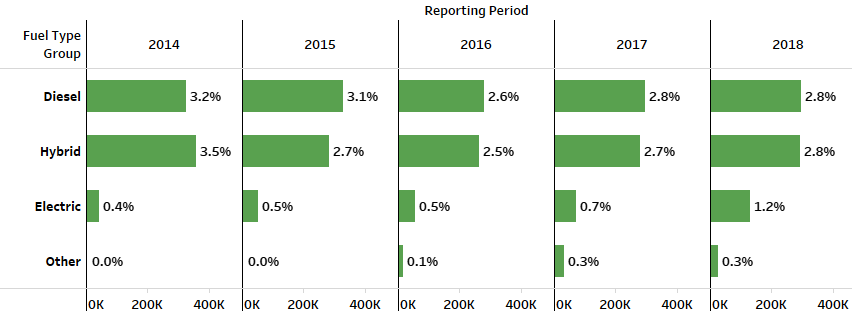
Chart details alternative fuel vehicle registrations through Q3, year over year.

Alternative fuel vehicle registrations through Q3, year over year.

It’s worth noting that gasoline-powered cars still dominate the market, making up 92.9 percent of registered vehicles through Q3 2018. But, the demand for alternative fuel type options should not be underestimated. Alternative fuel vehicles are becoming a significant segment in today’s auto market, and the large growth in EVs are a testament to that growth.

While EVs are proving to be a popular option compared to other alternative fuel types, other options remained steady. Diesel vehicles maintained 2.8 percent of the market year-over-year, while hybrid vehicles saw a slight increase since 2017, growing from 2.6 to 2.8 percent of the market.

A picture of the alternative fuel buyer

So, who’s investing in these alternative fuel vehicles? We see that most buyers tend to be married, single family home owners with a college education, and belong to either the Baby Boomer generation or Gen X. It’s interesting to note that EVs make up a notable percentage of registrations of alternative fuel type preferences across generational car buyers, according to Q3 registration data.

Among Baby Boomers, EVs fall second to hybrids, accounting for 1.0 percent of registered alternative fuel type vehicles compared to 1.2 percent respectively. But, EVs made up the biggest share of alternative fuel type registrations among Millennials (1.1 percent) and Gen X’ers (1.2 percent).

With the number of vehicle options available on the market today, EVs stand out as a segment to watch within the auto industry. There’s a greater story beyond the numbers and understanding how to leverage the data at hand can provide the industry with a greater understanding of the EV market and its potential.

To learn more about the electric vehicle market and other alternative fuel type vehicles, view the full Q3 2018 Automotive Market Trends Analysis webinar.

Related Posts

Alternative fuel vehicles continued to gain momentum in the fourth quarter of 2025, driven by expiring electric vehicle (EV) tax credits and a growing preference for options that bridge the gap between full electric and traditional gasoline vehicles. According to Experian’s Automotive Consumer Trends Report: Q4 2025, alternative fuel vehicles accounted for 38.6% of new retail car registrations in the last 12 months, with 11% battery electric (BEV) and 27.6% hybrids and plug-in hybrids (PHEVs). This signals that the narrative about growth in consumer interest for alternative fuel is increasingly towards hybrids, not just full EVs. Taking a deeper dive, the Toyota Camry Hybrid led all alternative fuel car models, coming in 31.7% in Q4 2025. Rounding out the top five were Tesla Model 3 (19%), Honda Civic Hybrid (10.1%), Honda Accord Hybrid (9%), and Toyota Prius (5.3%). Interestingly, the Toyota Camry also stood out as the top model in both new and used car markets in Q4 2025, holding 12.2% of new car market share and 6.3% of used car market share. The Honda Civic ranked second in new car market share, coming in at 10.5% this quarter, while the Honda Accord secured the second spot in the used car market at 5.8%. The prominence of these vehicles leading both new and used car markets reflects a combination of strong new-vehicle sales and sustained demand in the secondary market. Data in the report also revealed strong loyalty within Toyota and Honda, with significant inflow between the two brands. For instance, 38.4% of Toyota Camry buyers replaced their vehicle with another Camry in Q4 2025, and 39.7% of Honda Civic buyers replaced it with another Civic. These trends reinforce the value of dealers monitoring evolving consumer preferences and aligning inventory with vehicles that offer fuel efficiency and flexible powertrain options as the market continues to shift. To learn more about car insights, view the full Automotive Consumer Trends Report: Q4 2025 presentation.

by Kirsten Von Busch 3 min read March 17, 2026

From the vehicles we drive to the way we purchase them, everything in the automotive industry is evolving as new technologies, shifting incentives, and changing consumer expectations continue to develop. As electrified vehicles continue to grow their presence on the road, Experian’s Automotive Market Trends Report: Q3 2025 took a deep dive into this segment and found that 5.5 million electric vehicles (EVs) and 11.7 million hybrids were in operation this quarter. Furthermore, data through the third quarter of this year found that 73.8% of EV owners returning to market replaced their EV with another EV and only 16.5% switched to a gas-powered vehicle. The significant EV loyalty among consumers signals that the ownership experience is delivering on core expectations. While some owners continued to opt for an EV because they’ve grown accustomed to certain conveniences such as charging stations at home or workplace to avoid traditional fueling and the perks of lower maintenance needs, others took advantage of the EV tax credits before they expired at the end of September. However, as these motivations shift, it will be important to monitor how the EV market unfolds over the next six months. Notably, 11.7% of gas-powered vehicle owners replaced their vehicle with a gas-hybrid vehicle this quarter, suggesting that hybrids are acting as an effective bridge toward deeper electrification. In fact, drivers may see hybrids as the ‘happy medium’ vehicle that offers improved fuel efficiency without requiring full reliance on charging infrastructure. Why this matters for the aftermarket As the majority of consumers replace their EVs with another one and some switch their gas-powered vehicle for an electrified one, these trends signal potential long-term commitment to alternative fuel segments. This is important to monitor for aftermarket professionals as the EV service volume continues to grow, requiring different parts and technician training. With consumers increasingly turning to the aftermarket for cost-effective support, professionals who adapt to diverse powertrains will be best positioned to navigate this evolving wave of post-warranty demand. To learn more about EVs and other vehicle market trends, view the full Automotive Market Trends Report: Q3 2025 presentation on demand.

by John Howard 3 min read December 18, 2025

From shifting consumer preferences to aging vehicles reshaping service demand, data from the second quarter of 2025 revealed a dynamic landscape where new and used vehicle registrations grow, and the aftermarket “Sweet Spot” becomes a rich source for service providers. Experian’s Automotive Market Trends Report: Q2 2025 found that light-duty vehicles reached 293.5 million, up from 291.1 million through Q2 2024. This growth can be attributed to the 16.3 million new vehicle registrations and 39.5 million used vehicle ownership changes, demonstrating a healthy turnover in the market. Taking a closer look at the registration trends, new vehicle registrations saw a 7.7% year-over-year increase, reaching 4.2 million through Q2 2025. Meanwhile, used vehicle registrations also slightly increased by 2% from last year, rising to 10.2 million this quarter, as buyers continued to seek pre-owned options amid conversations around affordability. Leveraging aftermarket trends for service opportunities As vehicles age and warranties expire, there is a natural shift to aftermarket services, and the continuous growth in the aftermarket sweet spot shows that consumers are willing to keep their vehicles for longer periods of time, as long as they’re still functional. The aftermarket sweet spot is made up of vehicles aged 6-to-12-years old and are typically out of manufacturer warranty, making them prime candidates for aftermarket services. For instance, 35.5% of all light-duty vehicles on the road fell into this category through Q2 2025, signaling an opportunity for service providers and parts manufacturers. With total vehicle registrations on the rise and more vehicles entering the aftermarket sweet spot, it gives automotive professionals in all stages of the buying journey an opportunity to capitalize on these positive trends and meet consumers where they are needed the most. To learn more about vehicle market trends, view the full Automotive Market Trends Report: Q2 2025 presentation on demand.

by John Howard 3 min read September 22, 2025

Subscribe to our Auto blog

Enter your name and email for the latest updates.

This site is protected by reCAPTCHA and the Google Privacy Policy and Terms of Service apply.